
22 Shaggy Bob Hairstyles for Women Over 50 With Thin Fine Hair


If your hair has gotten finer and thinner after 50, a shaggy bob may be the most flattering cut you can ask for. Choppy layering was practically invented to fake body and movement, and on thinning hair it does more work than any hot tool. The 22 versions ahead all deliver real volume — no round-brush marathon required.
You’ll find collar-length and jaw-length cuts, soft undercuts, and layered bobs with plenty of crown lift. Each one comes with what actually matters: where the layers sit, how to style it in under five minutes, and the exact words to use with your stylist. Most can be maintained every 6 to 8 weeks.
Your part is simple — skim for a shape close to your face and hair texture, screenshot two or three, and take them to your appointment. Everything here works with a texture spray, a little root lift, and fingers instead of brushes.
1. Chin-Length Shaggy Bob With Wispy Ends for Fine Hair

Chin length is deliberate: it keeps weight off the sides so what you have looks denser. Wispy, point-cut ends read as texture instead of thinning.
- Ask for: layers starting at the cheekbone, not the crown.
- Finish: light texture spray on damp hair, scrunch, air-dry 10 minutes.
- Avoid: a blunt line across the bottom — it shows every gap.
If the spray feels crunchy, you used too much. Two or three short bursts is plenty.
2. Textured Shaggy Bob With Micro Bangs for a Softer Face Frame

Micro bangs graze the brows and pull the eye up, away from the thinning sides.
- Length: mid-brow, so they’re not obvious grow-out.
- Shape: piecey and slightly uneven — never blunt.
- Extras: tinted brow powder along a sparse parting.
- Blow-dry: forward, then tap with pomade on fingertips.
Blunt bangs are the one thing to avoid here — they show scalp and gaps at the parting.
3. Layered Shaggy Bob With Crown Volume for Thinning on Top

This one is for loss concentrated at the crown. The cut builds a real volume pocket instead of faking it.
- Ask for: shorter layers at the top-back, longer ones toward the neck.
- Styling: lift roots with a round brush while blow-drying.
- Cheat: a clip at the crown for 5 minutes before you leave.
- Product: root-lift mousse, not gel.
Keep those top layers no shorter than 3 inches — anything tighter stands up like spikes.
4. Asymmetrical Shaggy Bob for a Modern, Face-Lifting Angle

One side longer than the other adds height and pulls the eye along a diagonal line, so thin density stops being the first thing people notice.
- Best for: uneven jawline or a short neck.
- Ask for: a difference of 1.5 to 2 inches, no more.
- Bring: a photo of the exact angle — “asymmetrical” means ten different cuts.
Longer side forward, shorter side tucked. That’s the whole styling routine.
5. Shaggy Bob With Curtain Bangs to Mask a Sparse Hairline

Curtain bangs part in the middle and sweep outward, covering the temples — usually the first place thinning shows.
- Length: long enough to tuck behind the ear on humid days.
- Blow-dry: toward your cheeks, not straight down.
- Product: nothing heavy at the root, or they separate.
Re-part your curtain bangs a half inch either way every few months so the same spot doesn’t thin further.
6. Silver Shaggy Bob With Razored Layers for Gray Hair

Gray hair is coarser and drier, so it holds razor and point-cut texture better than fine brown hair ever will.
- Ask for: razored ends in the last two inches only.
- Skip: bleach entirely — let the natural silver do the work.
- Care: purple shampoo once a week kills brass.
More than weekly and purple shampoo turns silver dull and flat, which undoes the volume you just built.
7. Soft Shaggy Bob With Side Part for an Instant Volume Illusion

A deep side part is the cheapest volume trick there is. It pushes hair up and across the crown, so the whole top reads fuller without a single product.
- Best for: a widening center part or a stubborn cowlick — moving the part off-center hides both.
- Part placement: start above the arch of one brow, not the middle of the head.
- Set it: blast the part with cool air for 10 seconds before you leave the house.
- Skip: heavy gels at the root; they glue the lifted section flat.
If your part keeps sneaking back, dry it in place with the nozzle pointing down the parting line, then don’t touch it.
8. Short Shaggy Bob With Undercut Nape for Cool, Airy Shape

An undercut nape removes bulk where you don’t need it, so the top reads fuller and your neck looks longer. It also cuts drying time in half.
- What it is: hair at the nape clipped short, usually a number 2 or 3 guard, blending into the bob above.
- Time saved: roughly 5 minutes of blow-drying if you wash daily.
- Upkeep: get the line tidied every 4-6 weeks; it grows out fast and loses its shape.
- Ask for: a soft blend, not a hard line, so regrowth looks intentional.
Tell your stylist you want the weight left in the top layers — the undercut should lift the shape, not thin out the whole cut.
9. Wavy Shaggy Bob for Thick-Looking Natural Texture

If your fine hair has any natural bend, a shag amplifies it into real waves. The choppy layers give each wave somewhere to sit, so the texture looks fuller.
- Start: apply a pea-sized curl cream to soaking-wet hair, scrunching upward.
- Dry: diffuse to 80 percent, then let the rest air-dry for a softer finish.
- Avoid: heavy oils and butters — they flatten fine waves within hours.
- Refresh: mist with water and scrunch again on day two.
Skip the curl cream if your hair is very fine — a light mousse scrunched in does the same job with less weight.
10. Straight Shaggy Bob With Piecey Ends for Slick, Sharp Texture

Dead-straight fine hair can look limp unless you give it contrast. A smooth top with pinched, piecey ends reads as deliberate styling rather than flat hair.
- Tool: flat-iron the top and mid-lengths smooth, working in thin sections.
- Finish: rub a dab of matte paste between fingertips and pinch the last inch of hair.
- Keep it light: more than a pea-sized amount turns piecey into greasy.
- Blunt or choppy: ask for choppy ends — blunt lines show every thin patch.
Do the pinch trick last, after everything else is set, and only on the very ends — mid-lengths should stay clean and smooth.
11. Shaggy Bob With Graduated Back for a Fuller Silhouette

A shorter, stacked back builds visible density at the nape and behind the ears. From the side, the silhouette looks rounder and thicker than it is.
- The cut: stacked layers at the back, gradually lengthening toward the front.
- Grow-out: graduated backs grow out gracefully — you can stretch visits to 8 weeks.
- Ask for: the surface layer kept long enough to cover the stacked lines underneath.
- Warning: if the top layer is cut too short, the steps show and the cut looks dated.
Take a photo of the back view you want. Most stylists cut the back by feel, and graduation is where thin hair either gains density or loses it.
12. Long Shaggy Bob With Face-Framing Pieces for Shoulder Coverage

This one grazes the collarbone — good if a shorter cut makes you feel exposed. The face-framing layers start at the chin, so thinning around the jaw gets hidden.
- Length: collarbone to just above the shoulder, with the shortest front pieces hitting mid-chin.
- Root product: light mousse at the roots only — mid-lengths and ends stay airy.
- Styling: rough-dry with your head flipped over for two minutes, then flip back and smooth the top.
- Trim: every 6-7 weeks to keep the front pieces from growing past the jaw.
Keep the mousse off your mid-lengths. On fine hair, product below the ears is what drags a long bob down.
13. Shaggy Bob With Hidden Layers for the Thinnest Hair

Hidden or “invisible” layers sit underneath the surface, so if the top layer is sparse there’s no see-through effect. Ideal for hair that’s fine but not sheer at the ends.
- Key technique: Channel-cutting removes weight from the under-layers without touching the surface length.
- Best for: Fine hair that still has density at the ends but looks flat on top.
- Avoid: Short surface layers on a sparse crown — they expose the scalp.
- Stylist ask: “Under-cut layers, keep the canopy solid.”
Ask for channel-cutting if you want maximum movement without removing weight.
14. Blunt-Line Shaggy Bob for Polish With Texture

A clean baseline at the bottom with shaggy layers above it — the blunt edge reads as thicker hair because it shows a solid line, not thinning strands.
- Key piece: A one-length baseline, cut straight across, no notching.
- Layers: Short and smooth near the crown, light texturizing at the ends only.
- Length: Chin to collarbone holds the blunt line best.
- Time: 5 minutes with a paddle brush and a rough blow-dry.
Shorter smooth layers near the crown and light texturizing at the ends give it bounce and a sharp shape.
15. Shaggy Bob With Bright Face Highlights for the Illusion of Depth

Highlights placed right around the face make hair look dimensional and, yes, more plentiful. This is the fastest visual fix for a thinning hairline.
- Colours: Go one or two shades lighter than your base — never more.
- Placement: A partial foil around the face, not full-head.
- Time: Every 10-12 weeks keeps the root line soft.
- Avoid: Platinum against dark roots — high contrast shows scalp.
Subtle and low-maintenance is the aim: blended lightness reads as depth rather than a colour job.
16. Curly Shaggy Bob for Defined Ringlets, Not Frizz

Curly shags are cut dry, curl-by-curl, so every ringlet gets its own shape. This is the one cut where a wet haircut will cost you the style.
- Key piece: Dry cut, curl-by-curl — book extra time.
- Styling: Diffuse on low heat, seal with a light gel cast, then scrunch it out.
- Skip: The round brush entirely — brushing dry curls turns them into a cloud.
- Refresh: Water and a pea-sized drop of gel in the morning.
Ask your stylist to cut to your curl pattern, not to a length on a chart.
17. Shaggy Bob With a Deep Fringe for Bold, Youthful Framing
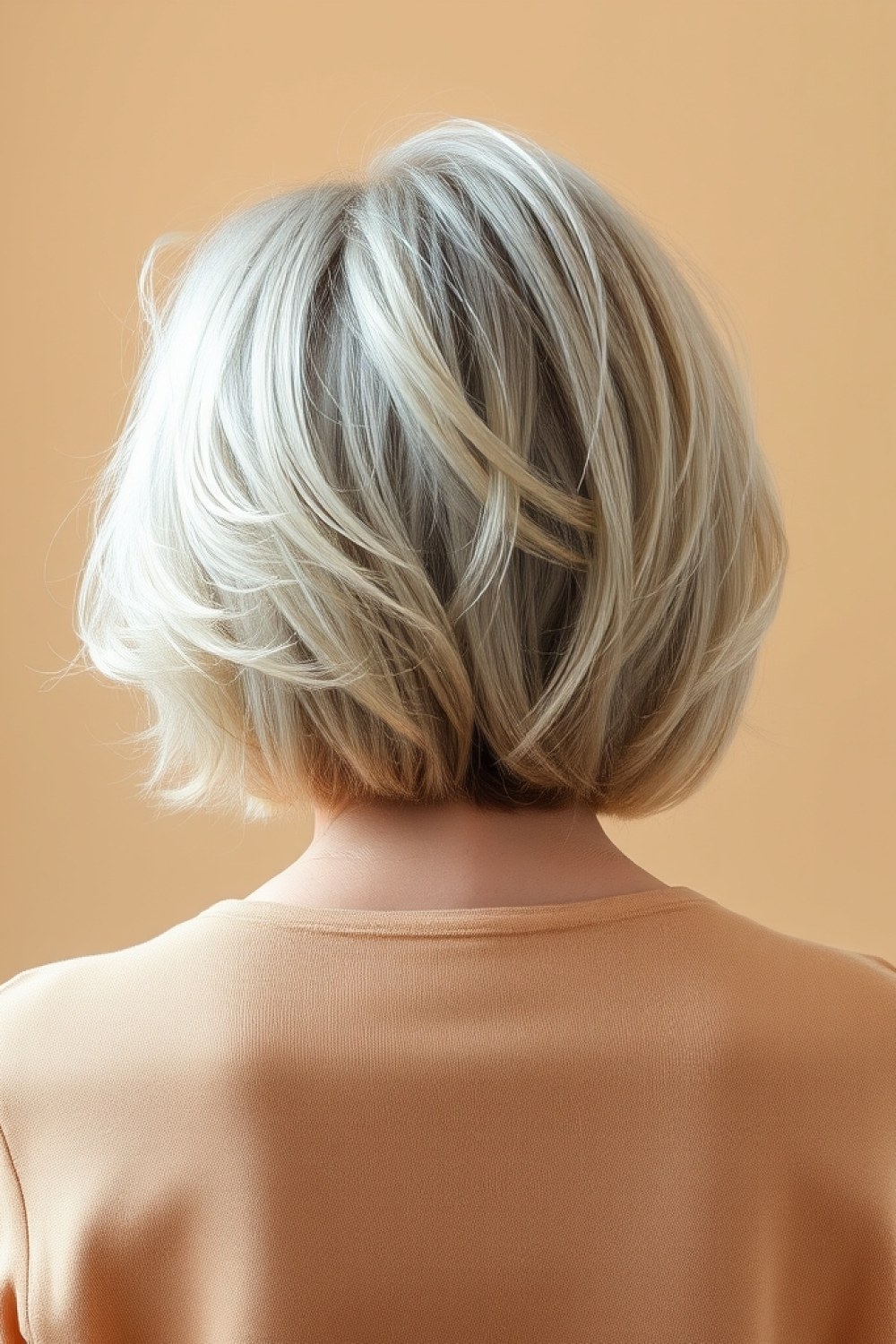
Heavy fringe isn’t off-limits on thin hair if it’s layered — ask for a soft, tapered fringe you can style to either side.
- Key piece: A tapered fringe cut with a razor or point-cutting, never blunt and heavy.
- Effect: Shortens the forehead and puts all the attention at eye level.
- Time: A free fringe trim between cuts every 3 weeks.
- Styling: Blow-dry side to side with a small round brush for lift at the root.
A soft fringe hides a thinning hairline better than any side part.
18. Tousled Shaggy Bob for a Just-Walked-In-From-Beach Look

Perfect for low-effort days — spritz with sea salt spray, scrunch, and go. The dry texture does the volume work for fine hair without weighing it down.
- Key product: Sea salt spray, 4-6 pumps through damp mid-lengths and ends.
- Technique: Scrunch upward, air-dry or diffuse on low.
- Finish: A tiny drop of cream on the ends only if they look dusty.
- Avoid: Salt spray on the roots two days in a row — it dries the scalp.
This is the style to wear when you’ve washed your hair the night before and want volume by morning.
19. Shaggy Bob With Balayage for Sun-Kissed Dimension in Fine Hair

Balayage keeps color off your roots, so regrowth blends and thinning at the part stays hidden. It also makes fine hair look denser than a flat single-process shade.
- Ask for: hand-painted pieces starting at the mid-lengths, not the crown.
- Shades: warm honey or caramel for yellow undertones; ash or pearl for pink-based skin.
- Skip: heavy all-over bleach, which flattens fine strands.
- Maintenance: a gloss every 8 to 10 weeks.
Book balayage two weeks after your cut so your stylist paints the layers exactly where they fall.
20. Micro Shaggy Bob for a Pixie-Bob Hybrid With Maximum Lift

This sits above the jaw and delivers the boldest root lift of the bunch. If you’re done fighting limp ends, it’s the cut that stops the fight.
- Length: jawline or shorter, with choppy point-cut ends.
- Time: trims every 4 weeks, so plan the salon budget.
- Styling: texturizing powder or sea salt spray on damp roots, then scrunch and air-dry.
- Revival: a pinch of powder at the crown brings back second-day lift.
Ask for the sides slightly longer than the back so it still reads bob, not buzz.
21. Shaggy Bob With a Middle Part for Grown-Out, Easy Elegance

A center part suits oval and heart faces and looks relaxed rather than severe once it’s layered. It’s the lowest-effort option on this list.
- Works best on: oval, heart, and long faces.
- Widening part: zigzag it with a tail comb to blur the line.
- Coverage: tap root powder directly along the part.
- Layers: chin-length face-framing pieces keep it from hanging flat.
Keep the part slightly off-center if your face is round — it adds height without looking strict.
22. Shaggy Bob With Soft Keratin or Bond Treatment for Strength

Not a cut, but the upgrade that makes any shaggy bob here last. Bond builders reduce breakage so your hair can actually gain length.
- At home: Olaplex No. 3 twice a month, 10 minutes before washing.
- In salon: a bond treatment every 6 to 8 weeks with your color.
- Keratin caution: a light smoothing can deflate fine waves — test it first.
- Ask: whether your texture suits smoothing before committing.
Stronger strands hold a shaggy shape longer, so you’ll stretch the time between trims.
Shaggy Bob Mistakes That Cost You Volume
These are the slip-ups that flatten a fine shaggy bob fast. Fix them and the cut does what you paid for.
- Long, blunt layers on top. If your shortest layers start below the cheekbone, the crown stays flat. You want the top layers hitting around the brow to temple so they lift and stack.
- Heavy conditioner on the roots. Conditioner meant for the ends creeps up and coats the crown. Keep it from your ears down, and rinse cool to close the cuticle flat.
- Cutting too much length at once. A shag needs weight to hold shape. Jumping from shoulder length to a short crop in one appointment gives you a thin, wispy result. Trim in stages.
- Over-texturizing. A stylist who thins with a razor all over removes density you can’t get back. Ask for point-cutting on the ends only, not thinning through the mid-lengths.
- Blow-drying downward from wet. Drying side to side flattens the root. Lift at the base with a round brush or flip your head over for the first few minutes.
Quick Questions
Will a shaggy bob make my thin hair look even thinner?
No, if the layers are placed right. The shag adds height at the crown and soft pieces around the face that read as movement, not gaps. It only backfires when the layers are cut too long or thinned too aggressively. Ask your stylist to keep density at the mid-lengths and texturize the ends only — that keeps the bulk where you need it.
How often do I need a trim to keep a shaggy bob looking full?
Every 6 to 8 weeks. Fine hair loses its shape and starts to look straggly once the ends grow out, and the layers separate instead of holding together. If you want to stretch it, book a 4-week dusting on the ends only, then a full reshape every second visit.
What products keep a shaggy bob voluminous without weighing it down?
Start with a lightweight volumizing mousse on damp roots, then a texturizing spray or sea salt spray on the mid-lengths and ends for grip. Skip heavy creams and oils near the scalp. A dry shampoo or root-lift powder at the crown on day two brings back height without a full wash. Two or three pumps total is enough — more than that and fine hair turns greasy by lunch.