
17 Pixie Bob Haircut Ideas That Actually Work


You saved the photo, screenshotted three more, and then stood in the mirror wondering if you’d actually look like her — or like you’d lost a fight with kitchen scissors. Here’s the good news: a pixie bob sits in that sweet spot between a full pixie and a chin-length bob, cropped and tapered at the nape, longer through the sides and front, usually landing somewhere between your jaw and your chin. Cut for your hair type, it’s one of the easiest short styles to actually live with.
The catch is that “pixie bob” means wildly different things depending on who’s holding the scissors. A graduated back, a blunt line, curtain bangs, silver tones, a stacked nape — each one flatters a different face shape, hair density and styling tolerance, and picking the wrong one is exactly how good intentions turn into six weeks of baseball caps.
So below are 17 real versions, from soft and undone to sharp and architectural. For each one you’ll get who it suits, how much styling time it asks for, what to tell your stylist, and the small details — neckline tapering, fringe weight, highlight placement — that separate a cut you love from one you grow out. Find your two or three favourites, then book the consult.
Quick Picks: Find Your Pixie Bob Fast
- Best for a first big chop: The Classic Graduated Pixie Bob (#1) — soft, forgiving, and easy to grow out if you change your mind.
- Best for fine or limp hair: Textured Pixie Bob (#3) or Stacked Back Pixie Bob (#12) — both build volume where you actually need it.
- Best for curly or wavy textures: Curly Pixie Bob (#4) or Wavy Undone Pixie Bob (#10) — cut to work with your pattern, not against it.
- Best for hiding a growing-out fringe or cowlick: Side-Swept Pixie Bob (#8) or Micro Bangs Pixie Bob (#7) — clever weight placement does the heavy lifting.
1. The Classic Graduated Pixie Bob
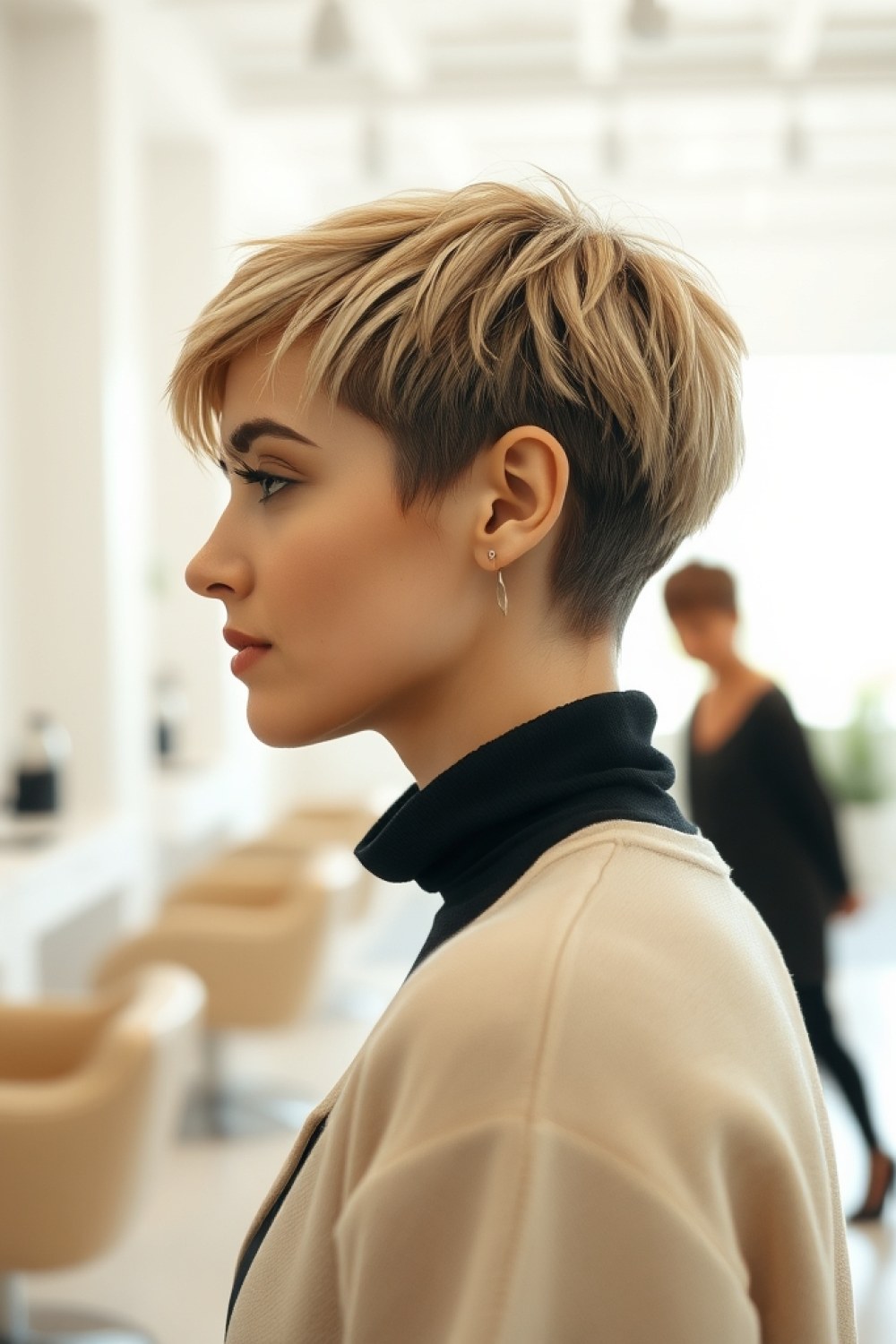
This is the blueprint: jaw-length at the front, stacked and tapered through the back so the silhouette curves right into your neckline. Ask your stylist for a soft, blended nape rather than hard clipper lines.
It’s the chop most stylists suggest first because it grows out into a neat short bob — no awkward mullet phase.
How to Style It
- Rough-dry until 80% dry, then switch to a small round brush.
- Lift at the root for volume, then flick the ends forward toward your face.
- Finish the back with a quick pass of the nozzle to smooth the taper.
2. Blunt-Cut Pixie Bob

One clean line at the jaw with hidden layers tucked inside for movement. It’s stunning on medium to thick straight or gently wavy hair — the weight does all the work.
Skip it if your hair is very fine. A blunt perimeter hangs flat and shows every gap.
How to Style It
- Part down the middle with a fine comb while hair is damp.
- Blow-dry straight down, following the cut line.
- Rub a pea-sized drop of light oil between your palms and smooth the ends only.
3. Textured Pixie Bob

Point-cut ends with lots of piecey separation — ideal for fine hair that needs grip. Your stylist should cut this one dry or mostly dry so they can see how your texture actually falls, not how it behaves when wet.
This is the version that looks like you “just woke up like this.” It isn’t, but nobody needs to know.
How to Make It Work
- Spray sea-salt or texture spray into damp hair, roots to ends.
- Scrunch with your hands and let it dry — no brush, or you’ll flatten the shape.
- Add a tiny bit of matte paste to the tips for definition.
4. Curly Pixie Bob

Cut curl-by-curl in its dry state so the shape ends up round and balanced — never a triangle. The back is tapered shorter, which stops curls from puffing out at the nape.
Find a stylist who specializes in curls. This cut lives or dies by their hands.
How to Style It
- Apply leave-in conditioner, then a palmful of gel, raking through sections.
- Scrunch upward, squeezing out excess water.
- Diffuse on low speed and low heat, or air-dry on lazy days.
- Scrunch out the gel cast once fully dry.
5. Tapered Nape Pixie Bob

A close, graduated nape with longer layers on top and around the face. Great if you have a thick or heavy hairline that gets hot at the back of your neck.
Request a soft taper, not a bald fade, unless you actually want that edge.
How to Maintain It
- Book a tidy-up every 4 to 6 weeks — this cut shows grow-out fast.
- Between visits, use a small brush to keep the nape smooth.
- Add a light-hold cream to the top layers for lift without crunch.
6. Bixie With Curtain Bangs

The bixie is a bob-pixie hybrid, and paired with curtain bangs it’s the most face-framing version on this list. Bangs start around the cheekbone and sweep outward, which flatters long and oval faces beautifully.
It’s soft, modern, and way easier to style than full bangs.
How to Recreate It
- Air-dry bangs around a Velcro roller for about two minutes.
- Remove the roller and push the bangs outward with your fingers.
- Set with a light mist of flexible-hold spray.
7. Micro Bangs Pixie Bob

Short, slightly uneven baby bangs sitting well above the brow. Bold? Absolutely. But surprise — they’re wearable when the rest of the cut stays soft and jaw-length. The trick is balance: cropped fringe up top, gentle graduation below.
Just know micro bangs show regrowth fast. Every 3 weeks, back in the chair.
How to Ask for Micro Bangs
- Request a light point-cut through the fringe so the line stays soft, not cartoonish.
- Say you want them above the brow, and bring a photo — “micro” means different things to different stylists.
- Keep the rest of the cut jaw-length and softly layered to balance the crop.
- Book a 3-week fringe trim, and ask if they do free bang trims between cuts.
8. Side-Swept Pixie Bob

A deep side part with a longer sweeping fringe is the most forgiving pixie bob for round faces, because that diagonal line adds length where you want it. It’s soft, low-risk, and styles in minutes once you know the motion.
How to Style It
- Scrunch a strong-hold mousse into damp roots for lift.
- Blow-dry the fringe across your forehead with a round brush, sweeping diagonally toward the opposite temple.
- Have your stylist keep the longer side at the jaw and taper the opposite side neatly behind the ear.
- Finish with a quick blast of cool air to lock the sweep in place.
9. Asymmetrical Angled Pixie Bob

One side cropped short and stacked, the other long enough to tuck behind your ear. It reads modern and a little editorial — and it’s seriously good for fine hair, because that diagonal creates the illusion of density you don’t actually have.
How to Recreate It
- Blow-dry the short side back and close to the head to emphasize the stack.
- Flat iron the longer side only, angling the iron toward your jaw as you go.
- Skip heavy product — this cut lives on its shape, and buildup flattens the diagonal.
10. Wavy Undone Pixie Bob
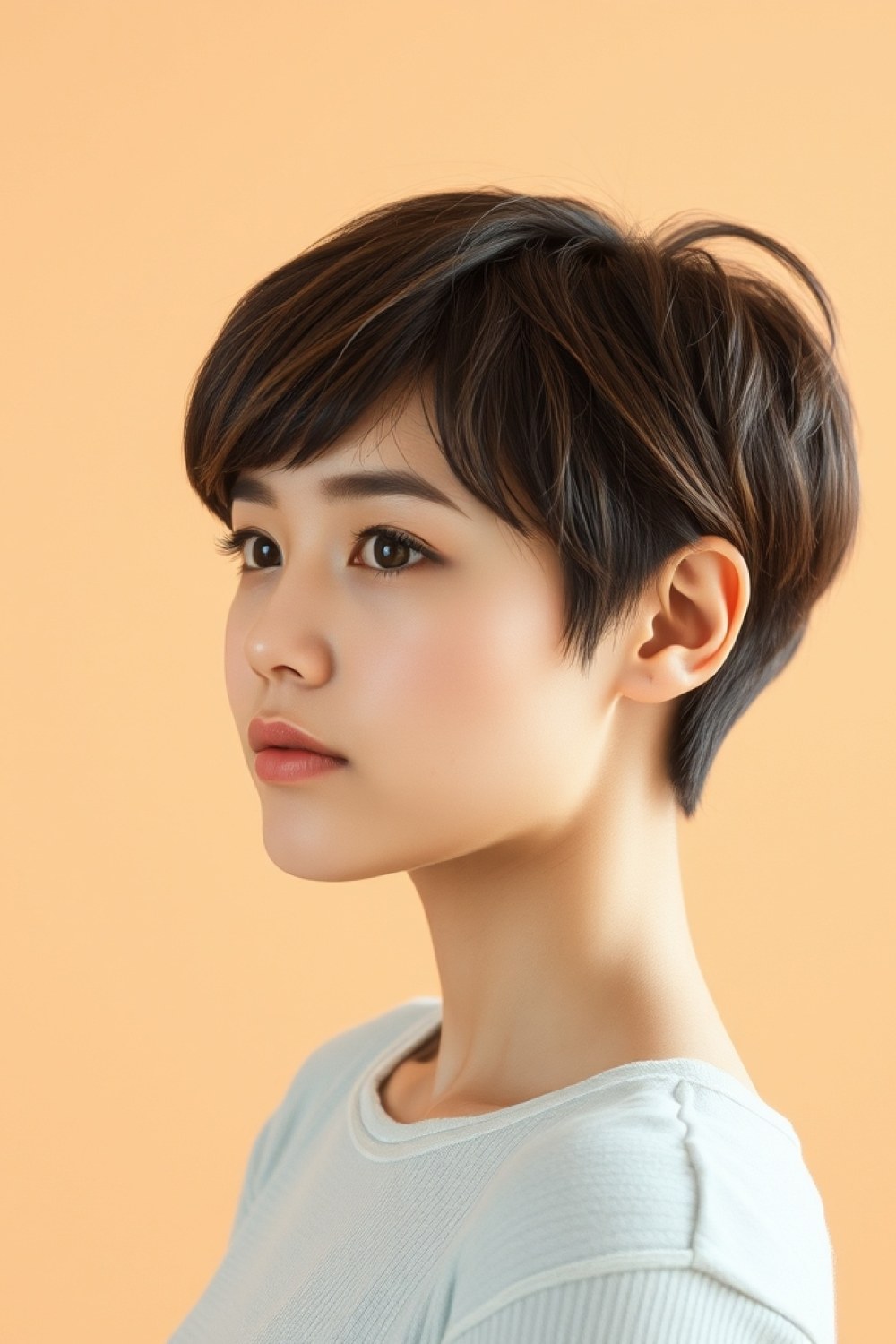
Cut for a lived-in, slightly messy finish with soft internal layers so it never looks “done.” If you have natural waves, this is your cut. Ask for the perimeter on the diagonal so it dries into shape instead of fighting you.
A light mousse and a five-minute diffuse on medium heat — that’s the whole routine.
How to Get the Undone Finish
- Apply lightweight mousse to damp hair and scrunch with your hands, not a brush.
- Diffuse on medium heat, five minutes, moving the dryer in small circles.
- Once dry, twist a few random pieces around your finger and let them fall — resist the urge to smooth them.
11. Sleek Blunt Pixie Bob

Glass-straight with a glossy, polished finish and a blunt or barely-softened line. It’s the most polished version on this list, and the most demanding — this one shows every bit of frizz and every crooked section.
Best on straight, medium-density hair. If you’re constantly fighting frizz, skip it; the textured versions give you far more forgiveness.
How to Get It Glassy
- Blow-dry completely smooth first — flat ironing damp hair is where the shine dies.
- Run the flat iron once over each section. One pass, no repeated pressing.
- Finish with a shine serum. Skip heavy oils — they dull the blunt line instead of polishing it.
12. Stacked Back Pixie Bob

Heavy invisible stacking at the crown and back builds real volume and a rounded, “lifted” shape. Perfect for fine hair that collapses at the crown by 10 a.m. The stacking stays hidden — you get the lift without visible layers.
How to Keep the Lift
- Ask your stylist to build the stack around your natural growth pattern, not against it.
- Blow-dry the back upward and forward with a vent brush to amplify the roundness.
- Book a trim every 6 weeks — past that, the stack grows out into a shapeless wedge.
13. Silver and Grey Pixie Bob
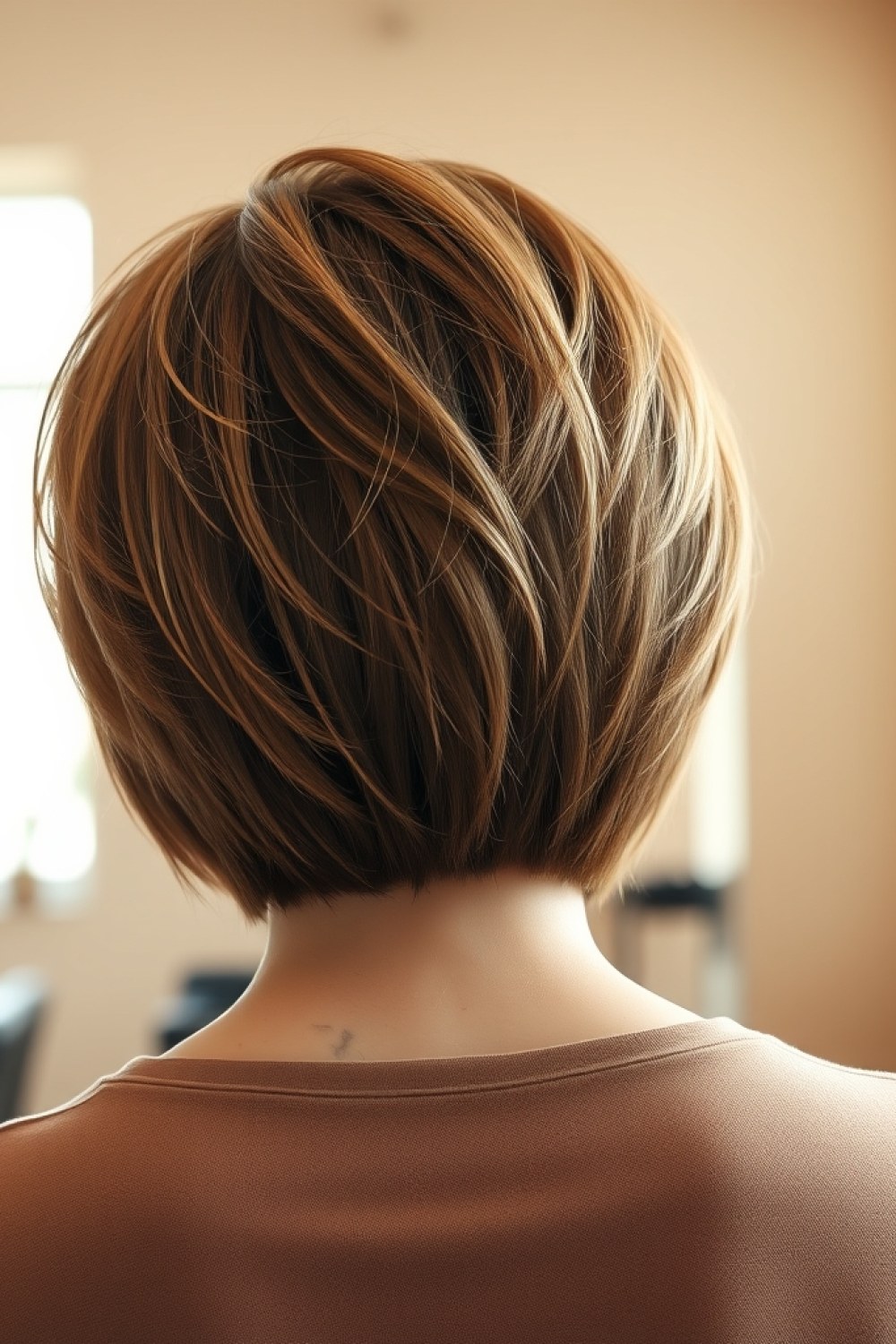
If you’ve spent years hiding your silver, a jaw-length pixie bob is the moment to stop. Short hair catches far more light, so grey and silver read as deliberate and polished rather than “I’m overdue for a root touch-up.”
The one enemy here is brass. Book a clear, cool-toned gloss every 6 to 8 weeks — it takes about 20 minutes and leaves silver looking crisp instead of yellowy.
How to Keep Silver Crisp
- Wash with a purple-toned shampoo once a week, leaving it on for 3 to 5 minutes before rinsing.
- Skip that shampoo on gloss week — doubling up can tip silver toward lavender.
- Ask your stylist for a clear gloss, not a blue one, unless you want a subtle steel cast.
- Use a heat protectant before straightening; silver shows heat damage fast.
14. Warm Honey Pixie Bob

Honey and caramel ribbons through a jaw-length cut give you dimension without the constant salon visits that full balayage demands. Because there’s simply less hair to colour, you’re paying for a partial highlight — usually the top section and a few face-framing pieces — rather than a full head.
Less coverage also means less grow-out. As the cut gets trimmed every 6 weeks, the old colour disappears instead of sitting there in stripes.
How to Get the Honey Effect
- Ask for partial highlights on the top and around the face, keeping the sides and nape darker.
- Request a level 7 to 8 honey — going lighter than that on short hair can look washed out.
- Refresh with a sheer gloss at 8 weeks to stop honey drifting orange.
- Use a colour-safe shampoo; sulphate formulas strip warm tones quickest.
15. Chocolate Copper Pixie Bob

There’s something quietly expensive about a rich, single-process copper-brown on short hair. It’s one colour, applied root to tip, which means a faster appointment and a lower bill than any multi-tonal technique.
The catch: copper fades faster than almost anything else. Deep and neutral skin tones both carry it beautifully, but ask for a shade that leans warm rather than red-orange — that’s the difference between expensive and rusty.
How to Make Copper Last
- Switch to a sulphate-free, colour-safe shampoo from day one.
- Top up with a tinted copper mask every second wash, left on for 5 to 10 minutes.
- Rinse with cool water to slow fading, and keep hot tools under 180°C.
- Re-book a gloss at 4 to 6 weeks rather than waiting for a full re-colour.
16. Face-Framing Highlights Pixie Bob

This one keeps your natural base and adds brightness only where the hair actually meets your face — a handful of fine, hand-painted pieces at the front. It lifts the entire cut without touching the back, which is the part you barely see anyway.
Because the colour sits exactly where the hair gets trimmed most often, it grows out invisibly on a 6-week schedule. That’s the whole trick.
How to Ask for It
- Request a fine weave or babylights — not chunky slices, which make short hair look striped.
- Keep the pieces within one to two shades of your natural colour.
- Ask your stylist to paint them after the cut so the placement sits right.
- Book a trim every 6 weeks and the highlights maintain themselves.
17. Tucked-Back Pixie Bob
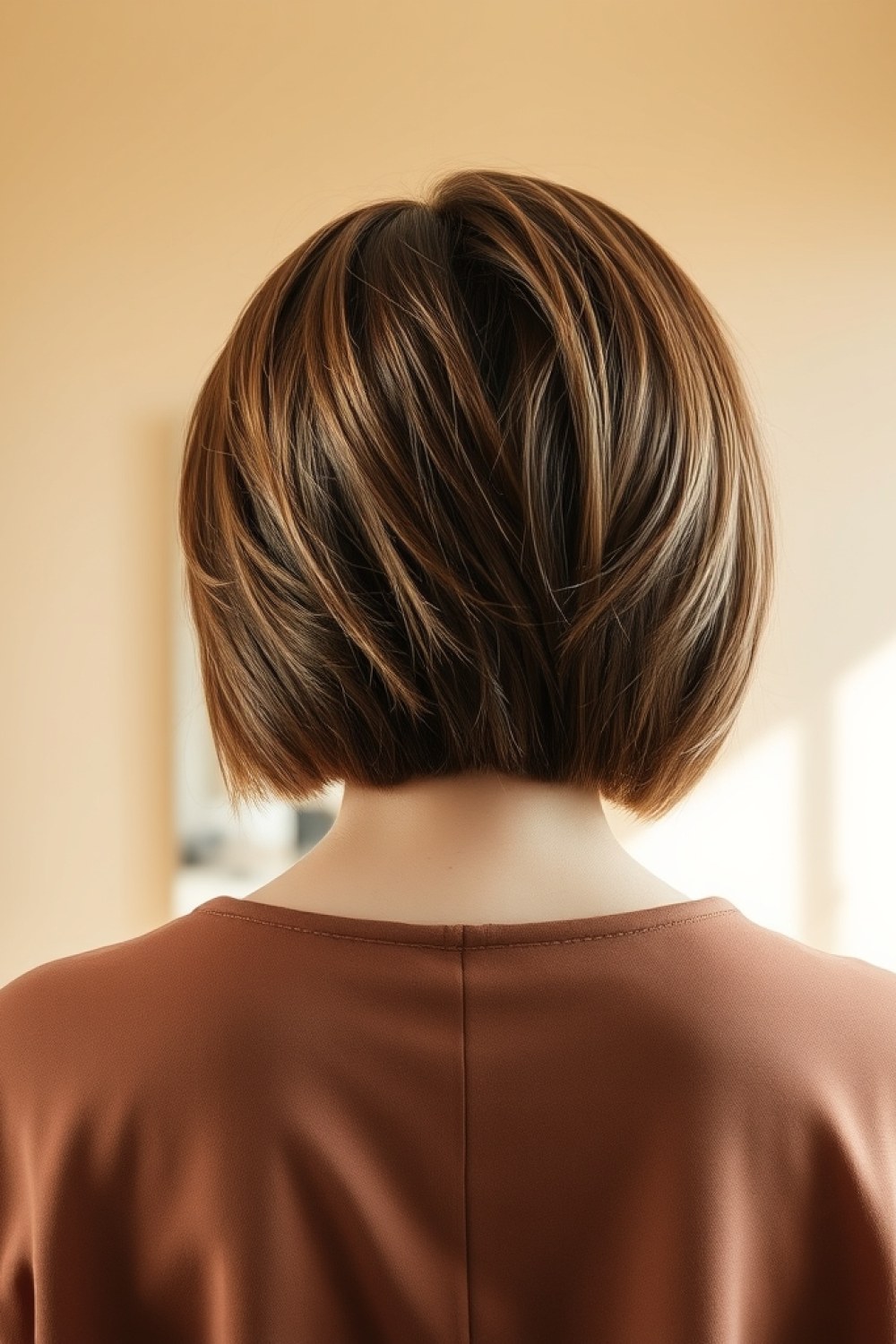
This is the pixie bob’s secret weapon: a jaw-length cut with just enough length on one side to tuck behind the ear or pin back. It completely changes your silhouette without a single snip — which makes it the best version for day-three hair.
It also works on fine hair, because tucking creates the illusion of volume at the front while the graduated nape stays flat and neat.
How to Style It
- Blow-dry with a round brush lifting at the root, then let the hair cool before tucking.
- Tuck one side behind the ear; leave the other loose for asymmetry.
- Secure with small flat clips or one bobby pin hidden under the tucked section.
- Pull two or three fine pieces forward at the temple so it reads soft, not severe.
Questions About Pixie Bobs
What’s the difference between a pixie bob and a regular bob?
A regular bob is one length or lightly layered, sitting between your chin and shoulders. A pixie bob keeps that jaw-length front but adds a graduated, tapered nape so it hugs the back of your neck like a pixie — short at the back, longer at the front. Think of it as the easiest stepping stone if you want a pixie but aren’t ready to commit to the full chop.
Will a pixie bob work on fine hair?
Yes — with the right construction. Ask for invisible stacking at the crown, point-cut texture through the ends, and a slightly angled perimeter. What you want to avoid is a heavy blunt line, which shows gaps and splits on fine hair. The textured and stacked-back versions in this list were made for fine hair specifically, so if that’s you, start there.
How often do I need trims to maintain a pixie bob?
Every 4 to 6 weeks for tapered or stacked versions to keep the nape and shape sharp. If you have micro bangs, book every 3 weeks — they lose their line fast. Softer, wavy, or tucked-back versions can stretch to 7 or 8 weeks because they grow out more gracefully and don’t need a crisp edge to look intentional.
How much styling time does a pixie bob need in the morning?
Honest answer: three to ten minutes. Textured, curly, and wavy versions can air-dry with a product and a quick scrunch. Sleek and blunt versions need a blow-dry or flat iron to look polished. If you want zero fuss, choose a cut your natural texture can handle instead of fighting it every morning.
Choosing Your Pixie Bob Before You Book
Bring two or three photos that show your actual hair texture, not just a shape you like — a sleek, thick-haired reference photo won’t tell your stylist much if your hair is fine and wavy. Ask them to walk you through the back of the cut before they pick up the scissors, because that’s where a pixie bob lives or dies. If you have fine hair, lean textured or stacked; if you’re round-faced, go side-swept or asymmetrical; if you want low maintenance, let your natural wave do the work.
And if you’re nervous — which is completely normal before a chop this big — ask them to cut it a little longer than your goal length and take it up after it’s dry. You can always go shorter. You can’t go back.